Rising 200 metres from the jungle floor, Sigiriya is not merely a fortress — it is a declaration carved in stone. We ascended at dawn, as the mist still clung to its ancient frescoes, and discovered why this UNESCO wonder remains one of the world's most extraordinary human achievements.
There is a particular quality to the silence at Sigiriya at 6am. The jungle below is still deciding whether to wake, and the stone steps leading upward disappear into a thin layer of mist that clings to the ancient rock face. This is the right time to come.
Built by the patricidal king Kashyapa I between 477 and 495 AD, Sigiriya — the Lion Rock — was never merely a fortress. It was a statement of supreme, almost divine, power. Having seized the throne by entombing his father alive and driven off his brother Moggallana, Kashyapa chose this 200-metre-tall granite monolith at the heart of the Sri Lankan jungle as the site of his celestial city. He would be a god-king, and his palace would be literally above the clouds.
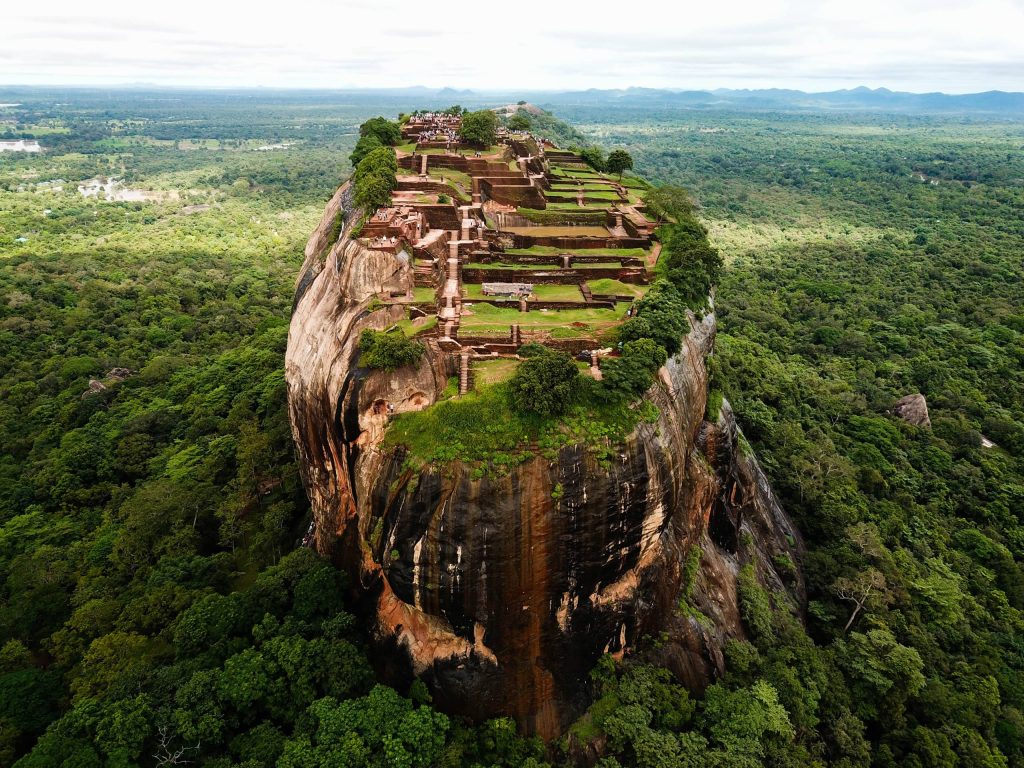
The iconic Sigiriya Rock Fortress, rising 200 metres above the Central Plains of Sri Lanka.
The Water Gardens: A Masterpiece of Ancient Engineering
The approach to Sigiriya begins long before the rock itself. The outer precinct holds what many archaeologists consider the oldest surviving landscaped garden in Asia. Symmetrical water gardens with stone-lined pools, fountains fed by underground hydraulic systems, and perfectly geometric pathways extend for nearly a kilometre. Incredibly, some of the fountain jets still function during the rainy season — 1,500 years after they were designed.
Walking through them at first light, with the rock glowing pink ahead and white herons lifting from the pools, it is not difficult to understand why Kashyapa believed himself a deity. This is a landscape designed to impress and overwhelm.
The Frescoes: 1,500-Year-Old Celestial Maidens
Roughly halfway up, set into a sheltered overhang of the rock, are the famous Sigiriya frescoes. Originally there may have been 500 painted figures; today 21 remain. Depicted in warm ochre, yellow, and vivid green, these cloud maidens — sometimes interpreted as celestial nymphs, sometimes as the king's consorts — gaze outward with an extraordinary life and immediacy.
They are among the finest examples of ancient Sri Lankan painting, and, protected from the elements by their sheltered alcove, they have survived in remarkable condition. Photography is permitted but flash is strictly forbidden to preserve them. Stand before them and you feel, unmistakeably, that you are being observed.
“Sigiriya is not just a rock. It is a mirror held up to a civilisation at the height of its ambition. Every carved step, every painted face is a message that has survived fifteen centuries.”
— Theekshana, Heritage Guide
The Mirror Wall & Ancient Graffiti
Continuing upward, visitors pass the Mirror Wall — once polished so highly that the king could see his reflection as he walked past. Today, the surface is covered in ancient graffiti. Visitors from as far back as the 7th and 8th centuries scratched poems and observations into the plaster, making it one of the oldest collections of inscriptions in the world. Some are astonishingly intimate: love poems, philosophical musings, and sharp wit that reads as freshly as anything written today.
The Lion's Paws & the Summit Palace
At the base of the final ascent, two enormous lion paws — all that remains of a colossal lion gateway that once marked the entrance to the summit — frame the final staircase. Iron handrails (a modern addition) guide visitors up the near-vertical final section, emerging onto the flat summit plateau where Kashyapa's royal palace once stood.
The views from the top are staggering. The jungle spreads in every direction to the horizon, broken only by the glitter of distant reservoirs and, on a clear day, the faint silhouette of Adam's Peak to the south. Archaeologists have uncovered royal bathing pools, throne rooms, and audience halls on the summit. The infrastructure of an entire royal city, 200 metres in the air.
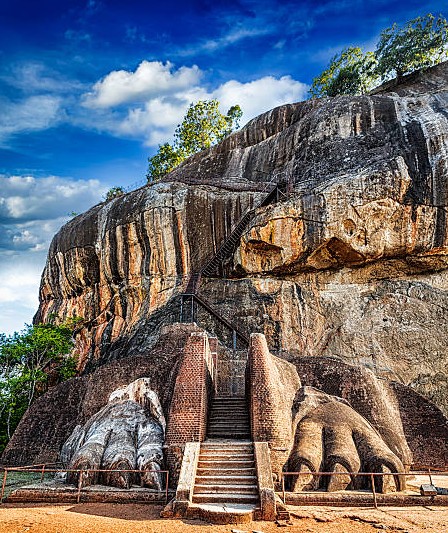
Sri Lanka's ancient cultural triangle is rich with extraordinary monuments from a great civilisation.
Practical Information
Expert Tip
Arrive at opening time (7am) or within the first hour to avoid the crowds and the equatorial midday heat. The climb takes between 1.5 and 2.5 hours round-trip. Wear comfortable shoes with grip, and carry at least 1.5 litres of water. Entrance tickets must be purchased in advance through the Central Cultural Fund; they cannot be bought at the gate.
- 1Opening hours: 7:00am – 5:30pm daily
- 2Entry fee: USD 30 per adult (foreign nationals)
- 3Best time to visit: Early morning (7–9am) for cooler temperatures and fewer crowds
- 4Nearest town: Dambulla (17km) or Habarana (12km)
- 5Combine with: Polonnaruwa, Dambulla Cave Temple, and Minneriya National Park
Inspired by this story?
Let our experts craft a bespoke Sri Lanka experience tailored exclusively for you.
Enquire Now