No wildlife encounter in Sri Lanka rivals the moment a Yala leopard locks eyes with you from a sun-drenched boulder. Here is everything you need to know for the perfect wildlife safari.
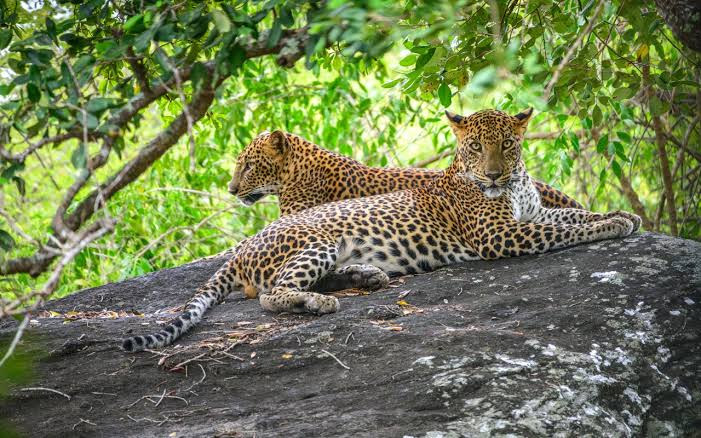
The jeep engine had been silent for eleven minutes. Our tracker, S.H. Premasiri — who has spent thirty-two years in Yala's Block One and can read the jungle like a native language — had raised his hand without a word. Then, from behind a rocky outcrop perhaps fifteen metres away, a leopard walked out into the morning sun.
She was large for a female, her amber eyes scanning the savannah with an unhurried authority that belongs only to apex predators. She settled onto a flat boulder, yawned enormously, and began to groom herself. For the next forty minutes, we barely breathed.

Yala National Park's Block One has one of the highest densities of leopards on Earth.
Why Yala Is the World's Best Place to See Leopards
Sri Lanka's leopard — Panthera pardus kotiya, a distinct subspecies found only on this island — exists at densities found nowhere else on Earth. Yala's Block One, covering 141 square kilometres of coastal dry zone scrub and rocky outcrops, supports an estimated 25 to 35 individual leopards: a concentration that makes sightings near-certain for any visitor who spends more than a day in the park.
Unlike leopards in Africa, where they are primarily nocturnal and tree-dwelling, the Yala leopard has evolved in an environment with no lions or tigers. Without competition from larger predators, they are highly diurnal — active by day, visible on rocks and open clearings, almost cavalier in their indifference to safari vehicles. This is what makes Yala unique.
Beyond the Leopard: Yala's Full Wildlife Cast
The leopard is the headline act, but Yala's wildlife script runs to many pages. Elephant herds — sometimes 30 to 50 animals moving together — move through the scrubland. Sloth bears, the most endangered of Sri Lanka's large mammals, are encountered regularly in the mornings. The birdlife is extraordinary: painted storks, black-necked storks, Ceylon jungle fowl, peacocks displaying at dawn, sea eagles riding thermals above the lagoons.
“People come to Yala expecting a leopard. What they leave with is an understanding that the whole landscape is alive — every square metre has a story.”
— Bimsara, Wildlife Specialist
When to Go & How to Do It Right
Yala is open year-round except during the annual closure period (typically mid-September to mid-October), when the park rests after the dry season crowds. The best game-viewing is from February to July, when the dry conditions concentrate animals around remaining water sources. Early morning safaris (departing at 5:30am) and late afternoon safaris (departing at 2:30pm) offer the most productive wildlife windows.
Expert Tip
Book a private jeep with an experienced naturalist guide rather than joining a group vehicle. The difference in the quality of your safari — the patience to wait, the knowledge to interpret, the routes chosen — is transformative. We recommend a minimum of two safaris to maximise your chances with the full range of wildlife.
- 1Park opening hours: 6:00am – 6:00pm
- 2Annual closure: Mid-September to mid-October
- 3Key species: Sri Lankan leopard, Asian elephant, sloth bear, crocodile, water buffalo
- 4Best for birds: Between November and April (migratory season)
- 5Nearest town: Tissamaharama (12km from park entrance)
Inspired by this story?
Let our experts craft a bespoke Sri Lanka experience tailored exclusively for you.
Enquire Now